
Which Tankless Water Heater Brands Are Actually Best?
Last Updated: November 19, 2026
Quick Summary
The best tankless water heater brands earn that title on heat transfer efficiency, accurate sizing to peak demand, and components that survive your water. Brand matters, but specification match matters as much as the unit itself, so sizing to real fixture demand and your water chemistry decides performance.
- Condensing units capture exhaust heat for higher efficiency but need a drain path for acidic condensate.
- Size to simultaneous fixture demand and winter temperature rise, not to the number of bathrooms.
- A whole-home electric unit often needs multiple dedicated circuits and a panel with spare capacity.
- Soft water below roughly 3 gpg may only need an annual descaling flush.
- A well-maintained tankless unit commonly lasts around 15 to 20 years.
Table of Contents
- What Separates the Best Tankless Water Heater Brands
- Gas vs. Electric Tankless Systems: Which Type Fits Your Home
- The Best Electric Tankless Water Heater Options for Smaller Loads
- Inside the Navien Tankless Water Heater Lineup
- Inside the Rinnai Tankless Water Heater Lineup
- Inside the Noritz Tankless Water Heater Lineup
- Tankless Water Heater Installation Cost and Retrofitting Challenges
- Tankless Water Heater Maintenance, Water Hardness, and Lifespan
- Request a Tankless Assessment for Your Home
- Frequently Asked Questions
What Separates the Best Tankless Water Heater Brands
The best tankless water heater brands earn that title on three things: how efficiently they transfer heat, how accurately they size to your peak demand, and how well their components survive your water. At Tankless Hot Water Solutions & Plumbing, we install and service on-demand systems across the San Fernando Valley and Simi Valley.
Brand matters, but specification match matters as much as the unit itself.
Below, we break down how to read a spec sheet, which brands hold up in practice, and what installation and maintenance really demand.
Condensing vs. Non-Condensing: The Efficiency Divide
Condensing units capture heat from exhaust gases that non-condensing models vent straight outside, which pushes thermal efficiency higher and cuts standby heat loss to nearly nothing. Non-condensing systems cost less upfront but waste more fuel over time.
The trade-off is condensate. Condensing models produce acidic water that must drain to a neutralizer or appropriate location, and that adds installation complexity. In practice, this means a condensing unit needs a drain path nearby and slightly more venting care.
If you plan to stay in the home long term, condensing usually wins on fuel savings. If you are installing in a tight retrofit with no drain access, a non-condensing unit can still make sense.
Flow Rate, Temperature Rise, and Sizing for Peak Demand
Flow rate is measured in gallons per minute (GPM), and it only tells half the story. The number that actually determines whether your shower runs cold is temperature rise: the difference between your incoming groundwater temperature and your target hot water output.
A unit rated for a high flow rate at a modest temperature rise will deliver far less when winter groundwater drops. Sizing for peak demand means adding up simultaneous fixtures: two showers, a dishwasher, and a laundry cycle running at once.
A common mistake is sizing to the number of bathrooms rather than to actual fixture demand. A three-bath home with two occupants may need less capacity than a two-bath home with a large family and a soaking tub.
Gas vs. Electric Tankless Systems: Which Type Fits Your Home
The fuel decision is usually made for you by the house, not by preference. Gas and electric tankless units differ in how they heat, how much infrastructure they demand, and where they fail first. Understanding the mechanics keeps you from buying a unit your home cannot support.
How each type actually heats water
Gas tankless units fire a modulating burner against a copper or stainless heat exchanger. Brands such as Noritz and Rinnai are well known for building this kind of unit. The burner throttles up and down to hold outlet temperature as flow changes, which is why a quality gas unit can serve a shower and a dishwasher at once without a temperature swing. Propane behaves the same way but carries roughly half the energy per gallon of natural gas, so a propane unit needs a larger gas supply and often a larger storage or delivery arrangement.
Electric tankless units pass water over high-wattage resistance elements. There is no exhaust, no vent, and no condensate, which simplifies the install. The constraint is amperage: a whole-home electric unit can draw enough current to require a dedicated service upgrade, and the elements stage on and off in steps rather than modulating smoothly.
The gas-side constraints
A gas tankless unit needs a gas line sized for its maximum input, not its average. Undersizing the line causes pressure drop at high fire, which shows up as a burner that short-cycles or a unit that throws an ignition fault under heavy demand. A retrofit from a tank unit can require a larger diameter run from the meter, and sometimes a meter upgrade. Venting is the second constraint: condensing gas units need a properly sloped PVC or polypropylene vent that terminates per local code, and non-condensing units need a stainless or Category III vent. A vent route that looks easy on paper can require a new wall penetration once the mechanical space is inspected.
The electric-side constraints
Electric tankless units are rated in kilowatts, and the circuit amperage follows directly from that rating. A whole-home electric unit commonly needs multiple dedicated circuits and a panel with spare capacity; older panels frequently cannot supply it without an upgrade. Point-of-use electric units draw far less and can often run on a single dedicated circuit, which is why they suit a bathroom, kitchen, or guest suite.
A practical decision framework
- If the home has natural gas and adequate venting space, a condensing gas unit usually delivers the lowest operating cost and the highest whole-home capacity.
- If the home is all-electric with a modern panel and spare capacity, a whole-home electric unit is viable but should be sized carefully against actual fixture demand.
- If the panel is older or the load is small, a point-of-use electric unit near the fixture is often the smarter call than a service upgrade.
- If propane is the only gas available, compare the delivered cost per gallon against electric rates before committing.
The right answer is the one your panel, meter, and vent route can actually support.
The Best Electric Tankless Water Heater Options for Smaller Loads
For a single bathroom, a guest suite, or a kitchen addition, an electric point-of-use unit can be a suitable choice. These compact units mount near the fixture and avoid the standby heat loss of a storage tank.
The catch is electrical capacity. Before buying, confirm the circuit amperage available at the location. Many older homes need a dedicated circuit run, and that cost belongs in your budget alongside the unit itself.
Small households, one or two people, frequently ask whether tankless is overkill. It can be a good fit, provided the unit is sized to actual demand rather than to the number of bathrooms.
Inside the Navien Tankless Water Heater Lineup
Navien is a manufacturer whose tankless water heater line includes condensing models, built-in recirculation options, and digital controller interfaces.
Recirculation pumps and heat exchangers need periodic descaling, and access matters for routine service.
Inside the Rinnai Tankless Water Heater Lineup
Rinnai is another established tankless water heater manufacturer, with a lineup that spans condensing and non-condensing models along with recirculation-ready options for homes that want faster hot water delivery to distant fixtures.
As with any tankless unit, regular descaling and clear access for service keep a Rinnai system running at its rated efficiency.
Inside the Noritz Tankless Water Heater Lineup
Noritz is a long-standing tankless water heater brand, offering both condensing and non-condensing models sized for anything from a single fixture up to whole-home demand.
Scale buildup affects Noritz units the same way it affects other tankless systems, so periodic maintenance should be part of the ownership plan.
Tankless Water Heater Installation Cost and Retrofitting Challenges
Tankless water heater installation cost varies with the job. Retrofitting a home built for a tank system can require upgraded gas lines, new venting, electrical work, and condensate drainage.
The variables that move the number most:
- Gas line resizing to support the burner’s demand
- Venting route and termination, which can require new penetrations
- Electrical panel capacity for electric models
- Condensate neutralizer and drain path for condensing units
- Relocation of the unit, which changes water and gas routing
Plumbing code compliance is not optional, and inspectors check venting and gas connections closely. Tankless Hot Water Solutions & Plumbing offers flat-rate pricing by the job; see the website for current pricing or a quote.
| Retrofitting Factor | Why It Matters | Typical Impact |
|---|---|---|
| Gas line sizing | Burner needs adequate volume | Can require new pipe run |
| Venting route | Condensing units need proper termination | May need new wall penetration |
| Electrical capacity | Electric models draw high amperage | Panel upgrade possible |
| Condensate drainage | Acidic water needs neutralizer | Adds a drain connection |
| Unit relocation | Changes water and gas routing | Adds labor and materials |
Tankless Water Heater Maintenance, Water Hardness, and Lifespan
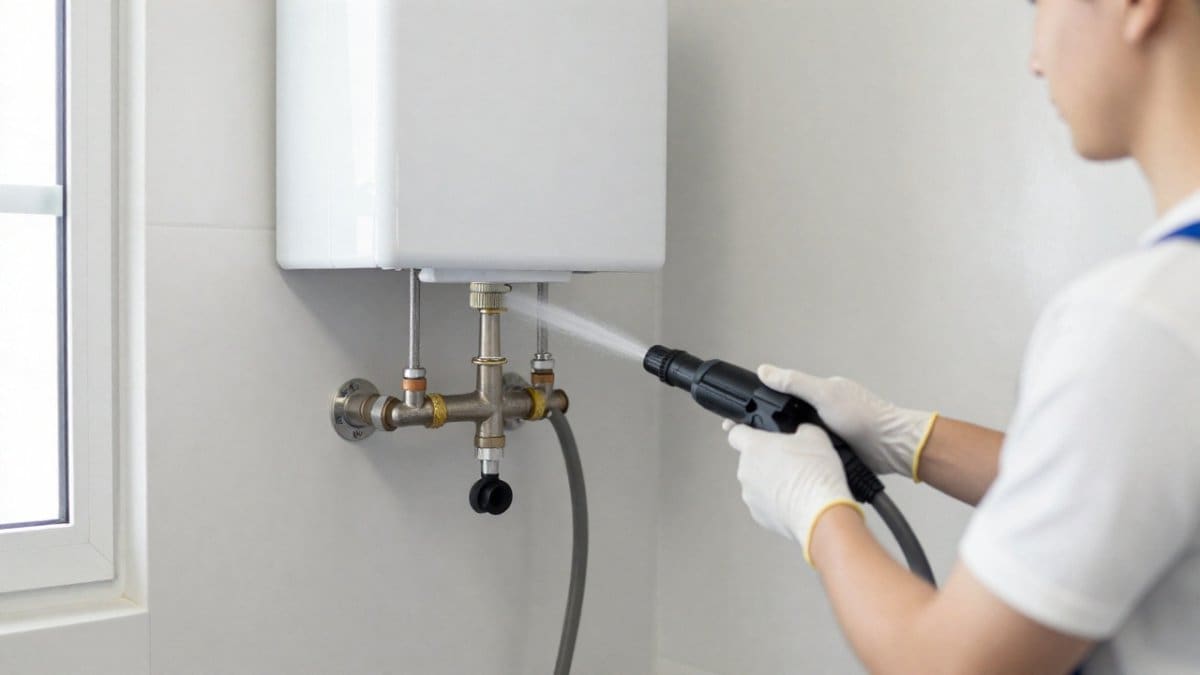
Most buying guides treat maintenance as a footnote. In practice, water chemistry determines whether a well-chosen unit lasts five years or fifteen, and it is the factor almost no competitor addresses. This section covers what actually wears out, how hardness drives service frequency, and what a realistic lifespan looks like.
What descaling actually removes
A tankless heat exchanger passes water through narrow passages. When water is heated, dissolved calcium and magnesium precipitate out as scale on the hot metal. Scale is an insulator: a coated heat exchanger transfers less heat, so the burner runs longer and hotter to hit the setpoint, and the unit’s efficiency drops. Descaling circulates a mild acid solution through the heat exchanger to dissolve that scale. The service is straightforward, but it requires isolation valves on the water lines; a unit installed without them turns a routine flush into a plumber’s disassembly job.
Hardness drives frequency, not a calendar
Water hardness is measured in grains per gallon (gpg). Soft water below roughly 3 gpg may only need an annual flush; moderately hard water in the 7 to 10 gpg range often calls for flushing every six to nine months; and very hard water above 10 gpg can require service every three to six months, especially in a high-use household. Because hardness varies by source and by season, the right schedule comes from a water test, not a generic reminder. A whole-home softener upstream of the unit changes the calculus entirely and can meaningfully extend service intervals.
The parts that fail first
- Heat exchanger: scale and corrosion are the leading causes of premature failure, and replacement often approaches the cost of a new unit.
- Flow sensor: debris and scale foul the sensor, causing the unit to fail to fire or to fire erratically.
- Igniter and flame sensor: wear items on gas units, generally inexpensive to replace.
- Recirculation pump: on units with built-in recirculation, the pump is a mechanical component with a finite service life.
- Pressure relief valve: should be checked at every service visit; a stuck valve is a safety issue.
Realistic lifespan expectations
A well-maintained tankless unit commonly lasts around 15 to 20 years, with heat exchanger warranty terms often running 10 to 15 years on premium models and shorter on budget lines. Hard water, skipped descaling, and undersized gas lines shorten that window. A tank unit, by comparison, typically lasts 8 to 12 years. The maintenance cost is real, but it is usually smaller than the cost of replacing a tank every decade.
A maintenance schedule that fits your water
- Test your water hardness once, and again if your source changes.
- Set a descaling interval based on that result rather than a fixed annual date.
- At each service, check the pressure relief valve, inspect the flow sensor, and verify venting on gas units.
- Keep the isolation valves and service clearances accessible so routine work stays routine.
A maintenance plan built around your actual water chemistry is the difference between a unit that delivers its rated efficiency for its full service life and one that quietly degrades.
Request a Tankless Assessment for Your Home
The gap between a good tankless system and a disappointing one usually comes down to assessment, not brand. Sizing to real demand, matching the unit to your water chemistry, and planning the retrofit properly are what make on-demand heating deliver.
Tankless Hot Water Solutions & Plumbing offers 1-hour appointment windows, flat-rate pricing by the job, and non-commissioned technicians. We offer zero cost for on-site visits in our service area and an online scheduler for tracking and payments. Join over 5,000 homeowners and over 500 Kindness Club members.
Get started with Tankless Hot Water Solutions & Plumbing and get a system sized correctly for your home the first time.
A tankless upgrade should feel like a clear decision, not a sales pitch. If you are weighing brands, sizing, or a tricky retrofit, our technicians will assess your home and quote a flat rate before any work begins.
Frequently Asked Questions
What is the most reliable brand of tankless water heater?
Reliability depends less on the logo and more on correct sizing, venting, and water quality. Brands with wide service networks and accessible parts tend to hold up best over time. A unit matched to your peak demand and temperature rise will outlast a larger unit that short-cycles. Ask any installer how they size the unit and whether they pull a maintenance history before recommending a brand.
Are Navien tankless water heaters reliable?
Many Navien models include built-in recirculation, which can reduce wait time at the tap. Reliability still comes down to installation: gas line sizing, venting length, and descaling on schedule. In hard water areas, skipping annual maintenance shortens the heat exchanger’s life regardless of brand. Have the installer confirm the model suits your flow rate and groundwater temperature before you commit.
Are Noritz and Rinnai tankless water heaters good options?
Noritz and Rinnai are both well established tankless brands with wide service networks, which makes parts and repairs easier to source. As with Navien, the deciding factor is correct sizing, proper venting, and a descaling schedule that matches your water hardness. Have the installer confirm the model fits your peak demand and groundwater temperature before choosing between brands.
How much does tankless water heater installation cost?
Tankless water heater installation cost varies with gas line upgrades, venting runs, electrical work for electric models, and whether you are retrofitting from a tank. Tankless Hot Water Solutions & Plumbing offers flat-rate pricing by the job; see the website for current pricing or a quote.
Are tankless water heaters worth the cost compared to a tank?
They make sense when you want endless hot water, floor space back, and lower standby heat loss. The trade-off is a higher upfront install and annual descaling. Households with high simultaneous demand, such as two showers plus laundry, need a unit sized for that peak or they will feel temperature swings. Run the numbers on your usage and water hardness before deciding.
